

Additional info:
Leon Alexandru Biju was a Romanian painter whose career was shaped by both rigorous academic training and extensive travel. Born in Bucharest into an intellectual family, he studied at the School of Fine Arts under G. D. Mirea and Ipolit Strâmbu, while also attending the Conservatory. In 1906, after a brief stay in Munich, he moved to Paris and enrolled at the Académie Julian, where he studied with Jean-Paul Laurens. His early years in France brought him to the Salon d’Automne and the Champs-Élysées exhibitions, where his work first gained recognition. Biju’s artistic trajectory was profoundly marked by his stay in Egypt, where he lived from1929 to 1933. During these years he painted landscapes, ancient monuments, and scenes of daily life, with a particular focus on portraits of women in local attire. This period culminated in a large exhibition at Sala Dalles in Bucharest in 1934, comprising 146 paintings and 100 drawings. The exhibition was praised by critics such as George Oprescu, who highlighted the seriousness and melancholy of his vision of Egypt, while Francisc Șirato emphasised his qualities as a colourist and the solemnity that endowed his compositions with a sacral aura. Between the wars, Biju exhibited regularly with the Artistic Youth Society and at the Official Salon in Bucharest, while also maintaining ties with the Parisian art scene. His works combined a realist approach with subtle decorative accents, reflecting both his academic training and his cosmopolitan outlook. Today, his paintings are held in major collections, such as the National Museum of Art of Romania and the National Bank of Romania, securing his place within the history of early twentieth-century Romanian painting.
You might also like:
-
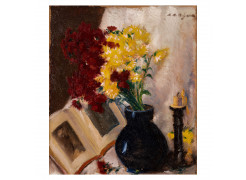 Leon Alexandru BijuSold for €1,725
 -
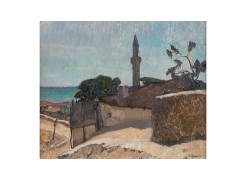 Leon Alexandru BijuSold for €2,684