

Additional info:
Adam Bălțatu holds a distinctive place in Romanian modern painting as a refined interpreter of the landscape. Trained at the Fine Arts School in Iași under Constantin Artachino and Gheorghe Popovici, he continued his studies in Rome after the First World War, attending the classes of Ettore Felice at the Accademia di Belle Arti. A formative trip to Paris in 1929 exposed him to the works of Vlaminck and Utrillo, encounters that decisively shaped his artistic vocabulary. While his early works still bore traces of academic discipline, by the late 1930s his vision had crystallised into an idiom that secured his place among the leading Romanian landscapists of the interwar period. Bălțatu’s oeuvre, spanning four decades and comprises over fourteen hundred works, reveals a marked preference for architectural settings and rural topographies rather than the bustle of human presence. His brushwork - lively yet controlled - combined with a nuanced chromatic realism, lends his paintings a lyrical intimacy. This orientation represented a deliberate break from the idyllic, folkloric discourse often associated with depictions of the Romanian countryside, situating his art within a modern sensibility attuned to both melancholy and serenity. The years 1938 to 1946 proved particularly decisive, with canvases from this period affirming him as a painter of quiet strength, attentive to the poetic resonance of natural and urban structures. Though echoes from Grigorescu and Luchian can be discerned, Bălțatu’s work is distinguished by its understated restraint and rejection of overt anecdote. His paintings offer the viewer neither social commentary nor heroic narrative, but instead a meditation on atmosphere, colour and the silent endurance of place. Frequently exhibited in Bucharest during his lifetime, his works have continued to attract collectors, their appeal grounded in the equilibrium they maintain between local identity and a European pictorial language informed by Impressionism and Post-Impressionism. Today, Adam Bălțatu is recognised as an artist whose art bridged tradition and modernity with discreet elegance. His canvases, resonant with muted emotion and delicate tonalities, embody a vision of Romanian landscape painting that transcends descriptive fidelity to become an enduring cultural artefact, valued equally as part of national heritage and within the international art market.
-
Shaker Hassan Al Said
1925 - 2004 -
Šárka Koudelová
b. Czech Republic, 1987 -
Laila Farcaș Ionescu
-
Andrei Cădere
1934 - 1978 -
Dorin Crețu
b. Brașov, Romania, 1956
You might also like:
-
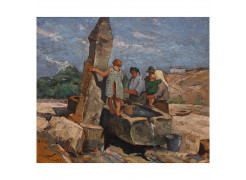 Adam BălțatuSold for €7,320