

Additional info:
Arthur Segal entered the European art world through a demanding academic trajectory shaped by studies in Berlin, Munich and Paris. This early formation situated him within the principal debates surrounding the transition from Impressionism to the modernist avant-garde, and it facilitated his involvement with groups such as Die Brücke and Der Blaue Reiter. His position in the Neue Sezession, founded in 1910, confirms his role within the artistic milieu that challenged academic conventions and promoted alternative modes of visual inquiry. During his years in Ascona he developed a more analytical approach to form, marked by measured chromatic structures and a controlled use of expressionist accents. The landscapes produced there rely on a restrained palette and present motifs reduced to essential relations of tone and light, a direction that later informed his theoretical position on what he termed objective painting. His graphic work from the same period, particularly the woodcuts with anti-war content, demonstrates a commitment to a clear ethical stance within the wider avant-garde. Segal’s return to Berlin in the interwar period brought renewed exhibition activity and an expanded pedagogical practice. His teaching emphasised the structural balance of colour, shadow and surface, and these concerns were articulated in his published writings of the 1930s. The paintings of these years shift from interiors and urban views to compositions governed by a more rigorous logic in which narrative elements are reduced in favour of clarity, order and controlled intensity. The political climate of the 1930s forced him to leave Germany, first for Palma de Mallorca and subsequently for London, where he founded another art school and maintained a steady presence within international artistic circles. His work, whether in painting, screenprint or graphic media, remains valued today for its precision and the consistency with which it interprets modern visual languages. It stands as evidence of an artist who negotiated several stylistic currents while preserving a disciplined approach grounded in analysis, pedagogy and lived experience.
-
Hala Ezzeddine
b. Arsal, 1989 -
Mona Hatoum
-
Adam Henein
Cairo, Egypt, 1929 - 2020 -
Ion Sălișteanu
b. 1929 -
Petru Lucaci
b. Arad, Romania, 1956
You might also like:
-
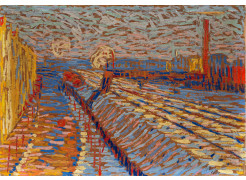 Arthur SegalSold for €24,400