

Additional info:
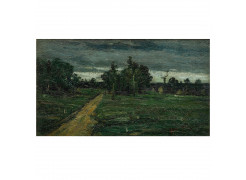
Ion Andreescu stands among the key figures of nineteenth-century Romanian painting, articulating a restrained and introspective alternative to the dominant picturesque mode of his time. His artistic formation was shaped within the institutional framework of the Bucharest School of Fine Arts, where rigorous training in drawing and compositional structure provided a foundation that he would later challenge through a markedly personal practice. Professional activity developed under persistent material and social constraints, most notably during the years spent teaching drawing in Buzău. This period proved decisive for the consolidation of his artistic language. Working consistently from direct observation, Andreescu cultivated a sober realist approach grounded in close engagement with landscape and ordinary motifs. Forest interiors, village margins, still lifes and isolated human figures recur throughout his work, treated with a reduced chromatic range and a dense tonal register that privileges structural coherence and atmosphere over narrative effect. A brief but significant encounter with the French artistic milieu, including the Barbizon environment and its commitment to painting from nature, sharpened his sensitivity to tonal construction and surface economy. Rather than prompting stylistic assimilation, this experience reinforced an independent idiom marked by austerity, introspection and a pronounced ethical gravity. In contrast to the lyrical naturalism favoured by many of his contemporaries, Andreescu’s painting resists decorative appeal, favouring compositional concentration and a reflective engagement with the motif. Exhibitions during his lifetime were limited, and contemporary recognition remained restrained, yet his works entered perceptive private collections at an early stage. Subsequent critical reception has positioned Andreescu as a pivotal figure in Romanian art history, valued for the coherence and maturity of an oeuvre curtailed by premature death. Within today’s art-historical and market contexts, his paintings are regarded as rare and exacting examples of late nineteenth-century realism, appreciated for their structural discipline, tonal restraint and understated psychological depth.
-
Cici Tommaseo Sursock
Split, Croatia, 1923 - Split, Croatia, 2015 -
Alphonse Mucha
Ivancice, Czechia, 1860 - Prague, Czechia, 1939 -
Helen Khal
Allentown, Pennsylvania, USA, 1923 - Ajaltoun, Lebanon, 2009 -
Iosif Fekete
Hunedoara, Romania, 1903 - Oradea, Romania, 1979 -
Constantin Aricescu
Văleni-Podgoria, Argeș, Romania, 1861 - Bucharest, Romania, 1933
You might also like:
-
 Sold for €54,900