

Additional info:
Jenő Kárpáthy, also documented as Eugène Karpathy, was formed within the academic and transnational artistic circuits of Central Europe at the turn of the twentieth century. His studies in Budapest under Bertalan Székely at the Mintarajziskola were followed by further training in Paris and Brussels, situating his practice within a broader European framework shaped by academic discipline and direct engagement with Western models. A significant stage of his professional development took place in Belgium, where he spent several years and participated in multiple exhibitions. This period consolidated a pictorial approach grounded in realist observation and plein air painting. After returning to Central Europe at the outbreak of the First World War, Kárpáthy continued to exhibit regularly, including group exhibitions at the National Salon in 1919 and 1921, the Műcsarnok in 1924, and a later joint exhibition in Debrecen in 1940 alongside Péter Szüle. His work is characterised by a consistent commitment to realist landscape painting, structured around direct visual perception and controlled composition. Natural motifs and atmospheric conditions form the core of his thematic repertoire, with limited interest in avant-garde experimentation. Within an art-historical and market context, Kárpáthy’s production aligns with early twentieth century Central European realist and plein air traditions, valued for technical coherence and stylistic continuity. Extending into the mid twentieth century, his career reflects a professional trajectory shaped by academic training, regional exhibition networks, and a sustained focus on observational painting, positioning his oeuvre within a stable and recognisable segment of the period’s artistic production.
-
Sonia Natra
Bucharest, Romania, 1925 - 2021 -
Willy Aractingi
New York, USA, 1930 - 2003 -
Mansour El Habre
b. 1970 -
Hala Mouzannar
b. 1968 -
Shafic Abboud
Bikfaiya, Lebanon, 1926 - Paris, France, 2004
You might also like:
-
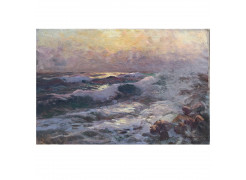 Jenő KárpáthySold for €793