

Additional info:
Milița Petrașcu occupies a distinctive position in the evolution of modern sculpture in Romania. Her artistic education unfolded across several of the principal European centres of the avant-garde: the Stroganov Academy in Moscow and the University of St Petersburg, followed by her immersion in the Munich milieu under Kandinsky and Jawlensky, and culminating in formative years spent in Paris, where she worked in the studios of Bourdelle, Matisse and Brâncuși. Her encounter with Brâncuși, which began after her debut at the 1919 Salon des Indépendants, proved decisive in shaping both her technical discipline and her understanding of form as a means of inner conviction rather than outward likeness. Although she absorbed the experimental ethos of the European avant-garde, Petrașcu retained a consistent commitment to figurative realism, pursuing expressive precision through structure and material. Her sculpture avoided pure abstraction, translating modernist reduction into a sober plastic language grounded in clarity, introspection and psychological truth. The portraits of George Enescu, Cella Delavrancea, Mihail Sadoveanu and Constantin Brâncuși demonstrate her acute perception of character and her interest in the metaphysical resonance of physiognomy. Her involvement in the Romanian interwar avant-garde connected her with the Contimporanul group and with feminist initiatives such as the Association for the Civil and Political Emancipation of Women in Romania. She exhibited regularly at the Official Salon in Bucharest and abroad in Paris, Brussels, Rome, Venice, New York and London, contributing to the international visibility of Romanian modern art. Among her public commissions, the monuments to Ecaterina Teodoroiu in Târgu Jiu and the mosaics for the Miorița Fountain in Bucharest stand out for their synthesis of narrative clarity and formal restraint. By the 1930s Petrașcu had defined a personal idiom that balanced the lessons of her European training with a lucid humanism rooted in observation. Her later retrospectives and institutional recognition consolidated her reputation as one of the foremost sculptors of twentieth-century Romania, whose work established a dialogue between modern innovation and ethical introspection.
-
Nicu Enea
Fălticeni, Romania, 1897 - Bacău, Romania, 1960 -
Zena Assi
b. Lebanon , 1974 -
Firu Zamfirescu
Ploiești, Romania, 1936 - Bucharest, Romania, 2020 -
Hafidh Al Droubi
1914 - 1991 -
Sorin Neamțu
b. 1977
You might also like:
-
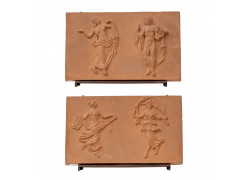 Milița PetrașcuSold for €1,220