

Additional info:
Sava Henția was among the first Romanian painters to articulate a realist visual language that bridged academic discipline with a growing preoccupation for social representation. Trained initially at the School of Fine Arts in Bucharest under Gheorghe Tattarescu and Theodor Aman, and later at the École Nationale Supérieure des Beaux-Arts in Paris with Alexandre Cabanel, he assimilated the compositional rigour of academicism while gradually renouncing its idealising conventions. His early works reflect the didactic clarity of his teachers, yet after his experience as a war correspondent during the Romanian War of Independence (1877–1878) his painting acquired a pronounced documentary character. The sketches and canvases produced on the battlefield anticipated a broader realist turn in Romanian art, concurrent with similar movements across Europe. In the subsequent decades, Henția’s focus on rural life, modest domestic interiors, and marginalised figures, signalled a decisive move away from heroic or allegorical subjects towards the representation of ordinary existence. His restrained palette, controlled drawing, and sober composition reveal a tension between his academic formation and the ethical demands of realism. Though his practice remained distinct from the later modernist idiom, it prefigured the moral and social consciousness that would shape the pictorial modernity of artists such as Ștefan Luchian and Camil Ressu. Henția’s career thus occupies a pivotal position within the formation of Romanian modernity. His realism does not merely imitate Western prototypes but translates them into a peripheral cultural context negotiating its own artistic legitimacy. In this respect, he embodies the dual impulse that defined nineteenth-century Romanian painting—the aspiration to synchronise with European artistic progress and the pursuit of an authentic national sensibility. His oeuvre, numbering over five hundred works and preserved today in major Romanian museums in Bucharest, Timișoara, Constanța, and Iași, remains a key point of reference for understanding how modern painting in Romania emerged from observation, discipline, and an ethics of representation.
-
Mazen Kerbaj
b. 1975 -
Ion Bitzan
Limanu, Constanța, Romania, 1924 - Bucharest, Romania, 1997 -
Edward Shahda
b. 1952 -
Doru Covrig
Deta, Timiș, Romania, 1942 - Paris, France, 2022 -
Tagreed Darghouth
b. Sidon, Lebanon, 1979
You might also like:
-
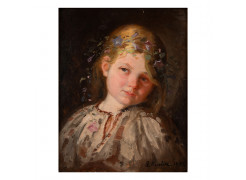 Sava HențiaSold for €15,860
 -
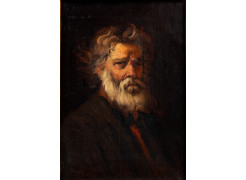 Sava HențiaSold for €4,880
 -
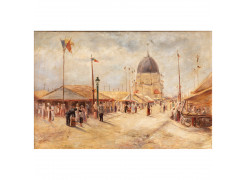 Sava HențiaSold for €4,880